Watch “New Zealand Trip in 14 Days (2016.12)” on YouTube
Not my video but a comprehensive video of all the different types of landscapes you can see in just 14 days in New Zealand.
From a personal perspective, watching this video may be a bad idea as it makes me want to jump back on a plane to NZ🇳🇿
Jacinda Ardern – New Zealand’s Prime Minister and youngest leader in the world!!
Jacinda Ardern became the youngest-ever leader of New Zealand’s Labour Party, she became the country’s youngest Prime Minister in 150 years, and its youngest female PM, ever. Her rise was so meteoric that it earned a proper name: Jacindamania. Ardern set new norms as a government leader when she gave birth, took six weeks maternity leave and shared that her partner will be a stay-at-home dad.
She said she is using her platform to “create a path for other women” to follow in her footsteps.
Rising to power on a tide of “Jacindamania,” at 38, she is the youngest female leader in the world and New Zealand’s youngest PM in 150 years.
As leader of the Labour Party, she promises an “empathetic” government, with ambitious plans to tackle climate change and child poverty.In July 2018, she announced welfare reforms including a weekly stipend for new parents and an increase in paid parental leave from 18 to 22 weeks.

Jacinda is a truly remarkable lady, this post does her no justice, please look her up! I wish politics in Ireland was as transparent and refreshing as in New Zealand!
Thanks Everyone!
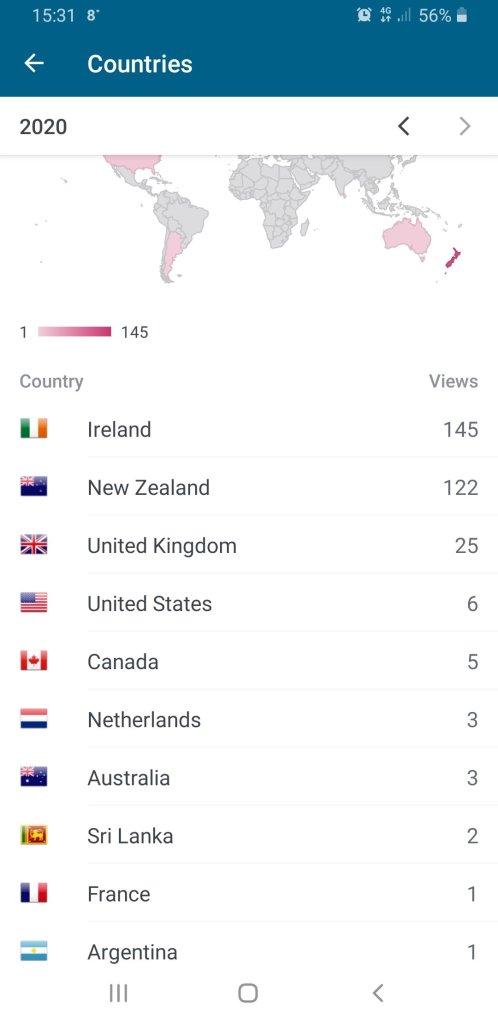
I shared a link to my website on facebook the other day and now I can see all the countries that my website has been viewed in! Thanks everyone!
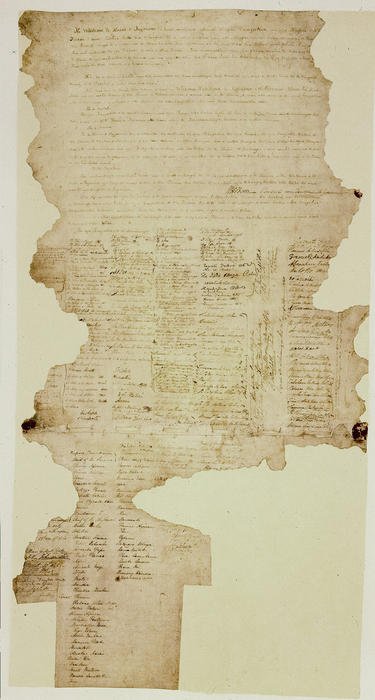
What is The Treaty of Waitangi?
New Zealand’s ‘The Treaty of Waitangi’ is named after the location that it was signed, and 6 February now marks the anniversary of its signing and has since become a New Zealand national holiday known as ‘Waitangi Day’.
Written in both Māori and English and containing three articles, the Treaty is a set of broad principles in which the Māori and British founded a nation state and agreed to build a government in New Zealand. The Treaty itself does not form part of New Zealand domestic law, except where it is inserted into specific legislation. It is instead looked at as a set of principles rather than an agreement, despite being the founding agreement of the New Zealand as a nation state.
Treaty: The English version and the Māori version
History tells us, however, that there was not a meeting of the minds in forming this agreement. The English version of the Treaty stipulates that the Māori people ceded sovereignty, gave the Crown exclusive rights to buy land that the Māori people wished to sell and in return are guaranteed full rights of ownership of their traditional lands, forests, fisheries and possessions and granted all the rights and privileges as British subjects.
The Māori version, however, contains nuanced differences that carry a significant meaning, for example, in the Māori version sovereignty is replaced by ‘kawanatanga’ which means governance. It has been argued that the Māori believed they remained a sovereign people free to handle their own affairs but gave up governing the lands. The Māori version also guaranteed full authority over ‘taonga’ which means treasures that may be intangible.
The British encroached upon the Māori understood terms of the Treaty and this led to countless disputes, particularly in the 1960s/70s when the Māori political movement was gaining traction and increasing its push to enforce the Treaty.
As a result of the Māori push, the Waitangi Tribunal was established in 1975 to consider claims made by individuals or groups and upon considering the evidence issues a report with recommendations. The Office of Treaty Settlements, established at the same time as the Tribunal, negotiates with the claimants on behalf of the Crown. Since establishment, there have been over 2,000 claims registered, giving an indication of the level of dispute between the Māori people and the New Zealand government.
A further area of dispute is the fact that claims negotiated by the Crown are settled on a large group scale and once settlement legislation is enacted, there are no further rights for that group to make any historical claims which completely ignores any (sub-tribe) and whanau (extended family) claims.
The Treaty of Waitangi on Waitangi Day is often reflected upon by many Māori people that that the ‘spirit of the treaty’ has not been honoured, such as retaining the right to govern their lands.
In Australia, despite last year’s attempt to supervise a process toward a treaty, or treaties, Indigenous people still do not have a treaty (and remain the only Indigenous peoples in the world to not have one with their colonists). However, if there were a move forward, the Waitangi example demonstrates the importance of linguistic nuances, ensuring that both parties understand exactly what is being agreed and neither party has an unfair advantage to the other when enforcing the terms of a treaty and the necessity of prescribed set of consequences for breach of terms of any Treaty.
Today we can reflect on the good intentions of the Māori people who signed the Treaty of Waitangi and honour our neighbouring brothers and sisters of New Zealand, by shining a light on the injustice of their people having a continued fight to uphold the Treaty.
Watch “February 6th: Waitangi Day, New Zealand” on YouTube
This video is more about interesting facts on New Zealand which are interesting but don’t really explore the significance of Waitangi.
I’ll post something more significant tomorrow…after all Waitangi day is the 6th Feb and although New Zealand are currently marking this day, we are still a day behind😆. Night everyone!
Waitangi Day!
Happy Waitangi day New Zealand! A post will follow soon detailing the significance of this day!
Fun and interesting facts!
- The world’s first commercial bungee jump was a 43 metre leap off the Kawarau Bridge in Queenstown in 1988.
- New Zealanders love their cars! 2.5 million cars for 4 million people (including the kids) makes New Zealand’s car ownership rate one of the highest in the world.
- Although it is around the size of Japan, New Zealand’s population is just over four million, making it one of the world’s least populated countries.
- In 1893, New Zealand became the first country to give women the right to vote.
- Sir Edmund Hillary, the first person to climb Mount Everest in 1953, was a New Zealander.
- Baron Ernest Rutherford, the first person in the world to split the atom in 1919, was also a New Zealander.
- It’s no wonder New Zealanders have always been ahead with regards to things like inventions and politics…. New Zealand is after all the very first country to greet each new day!
- While Rugby remains the most popular spectator sport in New Zealand, golf is the most popular participation sport, with more golf courses in New Zealand per capita of population, than any other country in the world.
- Auckland also has the largest number of boats per capita than any other city in the world.
- New Zealand won the first ever Rugby World Cup, held in 1987.
- New Zealand has won more Olympic gold medals per capita, than any other country.
- The Hector’s Dolphin, the world’s smallest marine dolphin, which grows to a maximum length of 1.5 metres, is found nowhere else in the world but in New Zealand waters.
- New Zealand is also home to the world’s only flightless parrot, the Kakapo.
- Dairy farmers produce a whopping 100 kg of butter and 65 kg of cheese each year, for each person who lives in New Zealand!
- Notable New Zealand filmmakers include ‘The Piano’ director Jane Campion and Peter Jackson, who made King Kong and the ‘Lord of the Rings’ trilogy.
- The most popular New Zealand films include ‘Once were Warriors’, ‘The Whale Rider’, ‘The Piano’ and the ‘Lord of the Rings’ trilogy.
- Here’s a really good reason to visit New Zealand – there are no snakes in the country!
- There are also no nuclear power stations in New Zealand.
- The Maori name for New Zealand is ‘Aotearoa’. It means “the land of the long white cloud”.
- Another great reason to live in New Zealand if you love surfing and other watersports is that nowhere in New Zealand is more than 120 km from the coast.
 Lydia's Mad about NZ!